
US plans record 86 GW of new power capacity in 2026 as solar and batteries lead
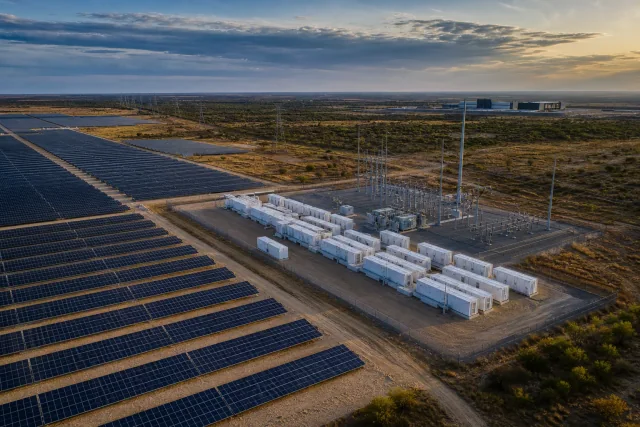
The EIA reports 86 GW of planned new US utility-scale capacity in 2026. Solar accounts for 43.4 GW and battery storage for 24 GW as load growth and AI infrastructure reshape the market's investment logic.
At a glance
The US power sector is heading towards its strongest year on record for new utility-scale capacity. If the reported projects are completed on schedule, 2026 will set a new annual high — with solar and battery storage alone representing almost four-fifths of the total.
Developers and operators plan to add 86 GW of new generating and storage capacity, according to the US Energy Information Administration's latest Preliminary Monthly Electric Generator Inventory. For comparison, 53 GW was added in 2025, the country's highest annual total since 2002.
Solar represents 51% of planned additions, battery storage 28% and wind 14%. In absolute terms, that means 43.4 GW of new utility-scale solar and 24 GW of batteries.
43.4 GW of new utility-scale solar
Solar remains the largest single category in the US construction pipeline. The reported 43.4 GW would be around 60% more than the 27.2 GW added in 2025 if all projects reach completion within their stated timelines.
Deployment is heavily concentrated. Texas accounts for around 40% of planned solar additions, while Arizona and California each represent 6%. Michigan adds a further 5%.
The scale of the build-out cannot be explained by climate policy or incentives alone. After years of relatively limited change in consumption, the US power system is entering a new demand cycle. Data centres, manufacturing investment and electrification are increasing the need for supply, while deployment speed is becoming almost as important as the cost of electricity itself.
Batteries are becoming core infrastructure
The planned 24 GW of battery storage is equally significant. The United States added a record 15 GW in 2025, and more than 40 GW of battery capacity has been connected to the grid over the past five years.
Around 80% of the 2026 additions are concentrated in three states. Texas leads with 12.9 GW, followed by California with 3.4 GW and Arizona with 3.2 GW.
This is changing the role of BESS in the investment model. Batteries are no longer viewed simply as an accessory to variable generation. They can shift energy between price periods, manage peaks, provide grid services and improve the commercial profile of renewable assets.
The largest solar project the EIA expects to enter service in 2026 illustrates that direction. Tehuacana Creek 1 in Texas combines 837 MW of solar capacity with a further 418 MW of battery power.
AI and data centres are reshaping electricity demand
Artificial intelligence is not the only cause of the new investment cycle, but it is now an important part of it. AI infrastructure and hyperscale data centres can create new loads faster than transmission lines, substations and conventional power stations can be delivered.
An updated Lawrence Berkeley National Laboratory analysis published by the US Department of Energy estimates that data centres could account for 11.8% of total US electricity use by the end of the decade. The modelled range is 9.5% to 15.3%, underlining how much uncertainty remains.
The Department of Energy identifies solar, land-based wind, battery storage and energy efficiency among the most rapidly scalable and cost-competitive options for meeting part of that demand. Reliable supply will still require a broader portfolio that includes grids, dispatchable resources and new firm generation.
It would therefore be inaccurate to describe the entire 86 GW pipeline as a direct consequence of AI. The more defensible conclusion is that rapid load growth increases the value of technologies that can be deployed relatively quickly and paired with flexible assets.
A record pipeline is not yet completed capacity
The EIA data reflects projects reported by developers and operators. It does not guarantee that every asset will enter service in 2026. Interconnection, permitting, supply chains, financing and regulatory changes can all move completion dates.
That caveat does not diminish the direction of travel. Even if individual projects slip, the composition of the pipeline is clear: solar supplies the largest volume of new generation, while batteries are becoming the principal tool for managing its hourly profile.
A signal for Europe and Bulgaria
The US market operates at a different scale and under a different regulatory framework, but the investment signal is relevant to Europe. The first major solar cycle focused on producing electricity at ever lower cost. The next is increasingly about when a megawatt-hour can be delivered and what it is worth to the system at that time.
As solar penetration grows, battery storage, intraday trading, grid access and the ability to respond to price and system signals become more important. This is particularly relevant to Bulgaria, where the rapid development of PV and BESS is already moving faster than parts of the required grid investment.
Planned additions of 43.4 GW of solar and 24 GW of batteries in a single year are more than another US renewable-energy record. They show how the power market begins to change when low-cost generation meets rapidly growing demand and storage moves from supporting technology to a central part of the investment model.