
TotalEnergies buys Shell’s European renewables business and brings KKR into a 1.2 GW portfolio
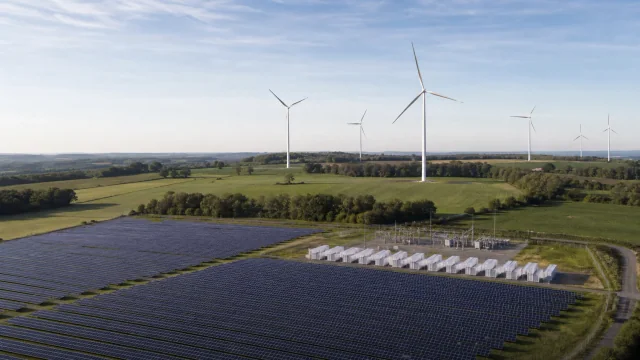
The two parallel transactions illustrate the evolving model of large renewable investors: acquiring development pipelines, retaining operational control and recycling capital through minority sales in advanced assets.
At a glance
TotalEnergies has announced two separate transactions that offer a clear view of how large energy companies are managing capital in Europe’s renewable power market.
The French group will acquire Shell’s entire European onshore renewables business. In parallel, TotalEnergies will sell a 50% stake in a separate 1.2 GW portfolio of solar and wind assets to a KKR-managed vehicle while retaining the remaining interest and operational management.
At first sight, buying and selling renewable assets at the same time may appear contradictory. In practice, both moves form part of the same model: acquire and develop projects, reduce investment risk and bring in long-term capital without surrendering control of the portfolio.
What TotalEnergies is acquiring from Shell
The Shell transaction includes around 500 MW of solar and wind capacity in operation or under construction, located mainly in Italy and the Netherlands.
It also adds an approximately 3.5 GW development pipeline covering solar, wind and battery storage projects in Italy, the United Kingdom and Spain. Once the transaction closes, the assets will be fully owned by TotalEnergies.
The companies did not disclose the purchase price. Closing is expected by the end of 2026, subject to the relevant regulatory approvals.
The acquisition strengthens TotalEnergies in four of its selected European power markets: Italy, the Netherlands, Spain and the United Kingdom. Before the transaction, its European renewables portfolio comprised close to 10 GW in operation or construction and around 27 GW in development, while global gross installed renewable capacity exceeded 37 GW at the end of June 2026.
Shell is not leaving the power market altogether
The sale should not automatically be read as a full withdrawal by Shell from power or low-carbon energy.
Shell says it is directing capital towards activities where it sees stronger competitive advantages, including power trading supported by physical assets, access to flexible generation and customer solutions.
This is a change in where the company positions itself along the value chain rather than necessarily an exit from electricity. Instead of owning the entire capital-intensive onshore solar and wind portfolio, Shell is concentrating resources in areas where it can combine generation, trading, flexibility and customer service.
Similar restructuring is becoming more common among large energy companies. Building a sizeable pipeline is no longer enough by itself; return on capital, asset integration and the management of price, production and balancing risk increasingly determine value.
Why TotalEnergies is selling 50% to KKR
The second transaction covers a separate 1.2 GW portfolio of onshore solar and wind assets in Germany, Spain, France and Poland.
TotalEnergies will sell 50% to a KKR-managed investment vehicle. The full portfolio carries an enterprise value of €1.8 billion. This is not the announced purchase price for KKR’s stake: enterprise value refers to the value of the underlying businesses and may include their debt.
TotalEnergies will retain 50% ownership and continue to manage the assets. Their electricity is already being sold, or will be marketed, by the company. Closing is expected during 2026 and remains subject to customary conditions.
This structure is often described as a farm-down. A developer advances projects to a more mature stage and then introduces an institutional investor for part of the equity.
TotalEnergies releases capital for new projects while keeping exposure to future cash flows, asset management and power marketing. The institutional investor gains access to a diversified portfolio of advanced or operating assets with lower risk than early-stage development.
Renewable assets are no longer valued by megawatts alone
The two transactions show that the value of a renewable portfolio depends on much more than its headline capacity.
Development stage, grid connection terms, permits, financing, power sales arrangements and the ability to combine generation with storage and flexible capacity all matter.
The battery projects in the acquired Shell pipeline are particularly relevant. TotalEnergies is building a model that combines renewables with flexible assets, including BESS and gas-fired generation, to supply electricity with a more predictable profile.
This marks a significant change from the early European renewables market, when the priority was simply to build as much generating capacity as possible. Large investors increasingly want portfolios that can operate within a broader power system combining generation, storage, trading and risk management.
The signal for Bulgaria
Although the transactions do not include Bulgarian assets, the model is directly relevant to the local market.
For developers, the highest investment value is likely to sit not with the largest announced capacity, but with projects that have mature permits, a credible grid-connection timetable and a clear route to market.
For owners of operating assets, adding BESS, securing long-term contracts or professionally managing merchant exposure may improve a project’s appeal to institutional investors.
The TotalEnergies transactions also show that selling assets does not necessarily mean that large capital is retreating from renewables. A disposal can be a way to fund the next development cycle.
Market maturity will therefore be measured not only by newly installed megawatts, but also by whether projects can be structured, operated and refinanced to deliver durable returns for different types of investors.