
Up to 9.7 GW of solar generation could disappear within hours: how the eclipse will test Europe’s grids
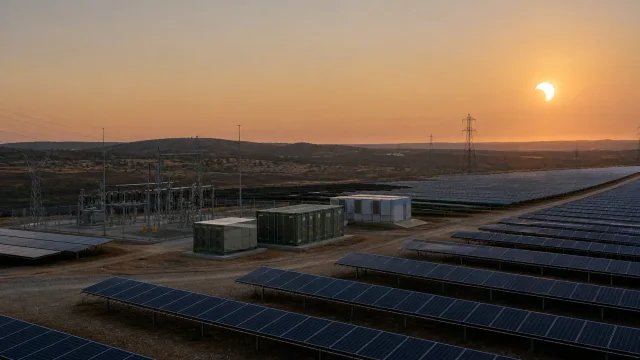
The total solar eclipse on 12 August will trigger a sharp but predictable change in photovoltaic output across parts of Europe. The event will not test whether Europe has enough energy, but how quickly grids, batteries and system operators can respond.
At a glance
The total solar eclipse on 12 August will cause a sharp but predictable change in photovoltaic generation across parts of Europe. For system operators, the event is another practical test for a power system in which solar and batteries now play a significantly larger role.
European transmission system operators are preparing for an unusually rapid change in solar output as the eclipse passes across parts of the continent. Spain will experience the strongest effect, with totality occurring close to sunset.
According to estimates cited by French transmission system operator RTE, clear skies could cause a temporary reduction of approximately 9.7 GW in European photovoltaic generation around the eclipse.
The scale itself is not considered a threat to security of supply. The more important issue is the speed at which generation will first fall and then recover, because those rapid changes must be balanced almost in real time.
The European Commission has indicated that no major impact on the electricity system is expected, in part because the eclipse will occur later in the day, when solar generation is already below its daily peak.
The rate of change matters more than an energy shortage
Solar eclipses are entirely predictable, giving system operators sufficient time to prepare.
From a power-system perspective, however, they reproduce one of the main challenges associated with a high share of weather-dependent generation: large amounts of capacity can change within a relatively short period.
As solar radiation declines, photovoltaic output falls. Once the eclipse passes, the process reverses and solar generation begins to rise again relatively quickly.
That dynamic must be balanced through a combination of other generation, interconnectors, battery storage, demand-side response and coordination between system operators.
This is not a new challenge for Europe. During the solar eclipse of March 2015, ENTSO-E identified the rapid change in photovoltaic output as a serious operational issue and prepared coordinated measures across European transmission system operators. The difference today is the scale of solar capacity connected to the system.
Europe’s power system looks different after only one year
ENTSO-E reports an exceptionally rapid change in the structure of the European power system over the past year.
According to the Summer Outlook 2026, Europe has added around 126 GW of renewable capacity since the previous summer, mainly solar PV. Over the same period, installed battery storage capacity has doubled to approximately 29 GW.
That combination changes how the system must be operated.
During periods of strong solar production, the increasingly common challenge is not a lack of electricity but excessive generation in particular hours. When solar output falls rapidly, the situation reverses and the system must quickly find replacement resources.
ENTSO-E therefore identifies storage, interconnection, demand-side response and operational coordination as increasingly important tools for maintaining balance.
Batteries are becoming a system resource
The expansion of BESS across Europe is particularly relevant during short-duration events of this kind.
Batteries can respond within seconds, absorbing or injecting power according to system conditions. That makes them useful not only for price arbitrage but also for balancing, reserves and the management of rapid changes in generation.
The doubling of European battery capacity in one year shows how quickly storage is moving from an addition to renewable projects towards becoming part of the core flexibility infrastructure of the power system.
This development is also relevant for Bulgaria, where substantial new BESS capacity has entered operation over the past year and storage is increasingly shifting energy from periods of strong daytime solar production into the evening.
The eclipse arrives during an unusually demanding European summer
The event on 12 August will occur against a background that makes operation of the European system more demanding than usual.
Prolonged heat and low river levels have already constrained part of Europe’s conventional generation fleet.
Low Danube levels have restricted output at Hungary’s Paks nuclear plant, while Romania has taken measures to maintain cooling at the operating reactor of Cernavoda. High river temperatures in France have also led to temporary restrictions on part of the country’s nuclear generation during the summer heat.
This does not mean that the eclipse creates an immediate threat to European electricity supply. ENTSO-E continues to assess the overall adequacy outlook for summer 2026 as favourable, with no systemic risk across most of the continent.
The combination nevertheless highlights a more important issue for the long-term development of the market.
The new question is how flexible the system can become
Europe’s energy transition is gradually shifting the focus from the volume of installed renewable capacity towards the ability of the system to manage that capacity.
With hundreds of gigawatts of solar PV, the value of electricity increasingly depends not only on how much is produced, but also on when it is produced and how quickly the system can respond when output changes.
The eclipse on 12 August will not test whether Europe has enough electricity.
It will be a more revealing test of the next stage of the energy transition: how an increasingly decentralised system with a major share of solar generation uses batteries, grids, cross-border trading and flexible demand to remain balanced during rapid changes in output.
That is likely to become one of the defining issues for Europe’s electricity market over the coming years.