
Deadline 1 September: €54.9 million for solar-plus-storage projects in three Bulgarian regions
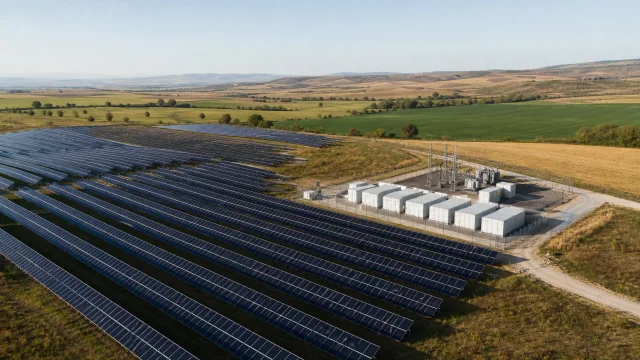
The EU RENEWFM call supports ground-mounted solar plants with integrated battery storage in Stara Zagora, Pernik and Kyustendil. Projects will compete not only on readiness, but also on the amount of support requested per megawatt.
At a glance
Applications are open until 1 September 2026 under the new call of the EU Renewable Energy Financing Mechanism, RENEWFM-2026-INVEST.
The call has a total budget of up to €54.9 million for projects in Bulgaria and Finland. Luxembourg provides the funding as the contributing country, while Bulgaria and Finland host the future generation capacity.
The €54.9 million is not reserved exclusively for Bulgarian projects. Applications from both host countries compete within one procedure, and the European Commission may leave part of the budget unallocated or redistribute funding between priorities according to the proposals received.
Eligible projects in Bulgaria
The Bulgarian part of the call is limited to ground-mounted photovoltaic plants located in the administrative districts of Stara Zagora, Pernik and Kyustendil.
Each project must have installed PV capacity between 10 and 100 MWp. Bulgaria has no predefined cap on the combined capacity of awarded projects, while Finland has a national ceiling of 400 MW.
Battery storage is mandatory for Bulgarian projects rather than an optional addition.
The PV plant and BESS must use the same grid access point. Battery rated power must be between 30% and 100% of PV rated power, with at least four hours of storage duration.
A 20 MWp solar project, for example, would require at least a 6 MW BESS. At the minimum four-hour duration, this corresponds to at least 24 MWh of usable energy capacity.
The requirement makes clear that the call is not funding a token battery attached to a solar project. The storage system must be capable of materially changing the generation profile, using grid capacity more efficiently and shifting a significant share of the electricity produced.
A competitive bid, not a standard fixed-rate subsidy
Applicants must bid the amount of support they require in euros per MWp of installed PV capacity. The bid cannot exceed €130,000 per MW; offers above the ceiling are ineligible.
For ranking, the requested support is converted into euros per MWh using an assumed 1,550 annual full-load hours for Bulgarian projects. Eligible and sufficiently mature projects are ranked from the lowest to the highest converted price.
Technical compliance alone is therefore not enough. Applicants must request a competitive level of support and secure their own or third-party financing for the remainder of the investment.
The award follows a pay-as-bid model: a selected project receives support based on its own bid multiplied by installed capacity. The European Commission may ultimately award a lower grant than the amount requested.
How mature must the project be?
The submission deadline is 1 September 2026 at 17:00 Brussels time. Applications are filed electronically through the EU Funding & Tenders Portal.
A project does not necessarily need a final construction permit and all grid-connection documents on the application date. They must, however, be secured before the grant agreement is signed and no later than nine months after the call closes. The indicative timetable points to grant signature in June 2027.
Applicants must provide a business plan, financial model, implementation schedule, co-financing declarations and evidence of relevant experience. Technical and financial maturity, the credibility of the timetable, full-project funding and the team’s delivery capability will all be assessed.
Public and private legal entities from eligible countries may apply, but the project itself must be built in one of the three designated Bulgarian districts. Individuals are not eligible except for certain self-employed persons under the call rules.
Commissioning and operating obligations
Awarded plants must enter operation by 1 March 2029 and remain operational for at least 15 years.
Bulgarian projects must demonstrate annual generation equivalent to 1,550 full-load hours, with limited tolerance in justified cases such as unusually adverse weather or mandatory grid curtailment.
If the required results are not achieved, the grant may be reduced proportionally. If the project never enters operation, the agreement may be terminated and funding already paid may have to be recovered.
Battery-specific requirements
At commissioning, a Bulgarian project must provide a ten-year battery supplier warranty covering 90% round-trip efficiency, at least 70% state of health at the end of the period and a minimum of 5,000 cycles.
Independent certification of the metering equipment is also required to measure on-site generation stored in the battery and later exported. Energy used to charge the system directly from the grid will not count towards the renewable generation obligation.
These requirements should be built into supplier selection and warranty negotiations from the outset. A standard commercial BESS offer that does not cover the required performance or evidence could create material risk for the grant beneficiary.
Why Luxembourg is funding projects in Bulgaria
RENEWFM allows one EU Member State to finance new renewable capacity built in another.
Under this call, Luxembourg provides the funds and projects are constructed in Bulgaria and Finland. In return, 80% of the statistically accounted renewable energy is allocated to Luxembourg and 20% to the host country over 15 years. This statistical allocation does not prevent the host country from issuing guarantees of origin.
The mechanism helps Luxembourg contribute to EU and national renewables targets by investing where projects can be delivered more efficiently. Bulgaria gains new infrastructure, investment and additional power generation.
A real opportunity with little preparation time
The call offers meaningful support, but it is designed for relatively mature projects. A site or early concept alone will not be sufficient.
The strongest candidates will already be advanced in planning, environmental and grid procedures, have a credible BESS design and be able to finance the portion not covered by the grant.
The bid level is also critical. Asking for too much may push a project out of the ranking, while bidding too little may leave a gap in the financial model.
A successful application therefore requires more than well-written documentation. Technical, administrative and financial investment readiness must be in place before the deadline.