
Coalburn 1 goes live: 500 MW / 1 GWh and a new scale for European batteries
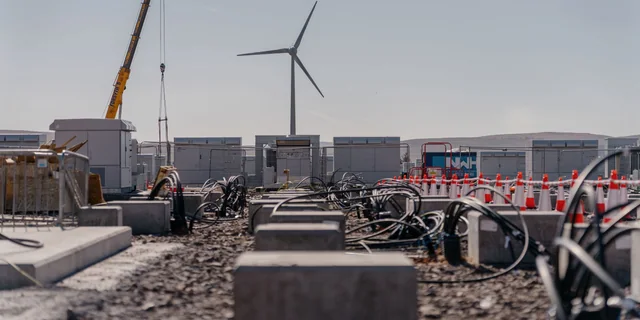
One of Europe’s largest operating batteries is now live in Scotland. Beyond the headline 500 MW / 1 GWh rating, Coalburn 1 offers a more useful lesson: how long-term contracts and institutional capital are reshaping the business model for utility-scale storage.
At a glance
Coalburn 1 is now operating in South Lanarkshire, Scotland. The battery energy storage system is rated at 500 MW with 1 GWh of energy capacity, allowing it to discharge at full power for approximately two hours.
Its commissioning marks a notable step for Europe’s storage market. Projects of this size are no longer an adjunct to an individual wind or solar farm. They are standalone pieces of energy infrastructure with enough scale to affect how a national power system is operated.
Copenhagen Infrastructure Partners (CIP), the investor behind the scheme, describes Coalburn 1 as Europe’s largest operational battery. Public records confirm the core technical parameters, while the contractor involved in commissioning says the work is complete and the facility is in full operation.
The first part of a 1.5 GW / 3 GWh portfolio
Coalburn 1 is the first of three large UK storage projects in CIP’s portfolio. Coalburn 2 in South Lanarkshire and Devilla in Fife are expected to take the combined portfolio to 1.5 GW of power and 3 GWh of storage capacity.
Scotland is a logical market for assets of this kind. The country has substantial wind generation, but transmission capacity towards the main centres of demand in southern Britain is often constrained. During periods of strong wind, this can lead to curtailment and additional costs for the system.
A large battery does not remove the constraint, but it can absorb part of the energy at the wrong time and release it when the network and the market can use it. That flexibility is what turns BESS from a pure trading asset into a system resource.
The revenue model matters more than the headline size
For investors, Coalburn 1 is notable not only for its nameplate capacity. The project has a 10-year optimisation agreement with SSE, placing the management of charging, discharging and market access in the hands of an experienced operator.
It also holds contracts under Britain’s Capacity Market. AXA IM Alts provides the more precise breakdown: a 15-year agreement covering 300 MW and a seven-year agreement covering a further 75 MW. That distinction matters, and is more accurate than describing the entire project as being covered by one 15-year contract.
The structure does not eliminate merchant risk, but it provides greater visibility over part of the future cash flow. For an asset representing more than £400 million of investment, that visibility directly affects the cost of capital and the willingness of long-term investors to participate.
Institutional capital is moving directly into BESS
In April 2025, AXA IM Alts acquired a 50% interest in the project, while CIP retained a leading role in its delivery and management. The transaction shows how large batteries are beginning to resemble other infrastructure investments, with risk divided between the developer, the optimiser and the financial partner, and part of the revenue base secured over longer periods.
This is a meaningful shift. Only a few years ago, utility-scale BESS was often treated as a new technology with difficult-to-forecast revenues. Coalburn 1 reflects a more mature model in which the physical asset, route to market and capital structure are designed together.
The lesson for Bulgaria
Bulgaria has also entered a rapid build-out phase for battery storage. The next question, however, will not simply be how many megawatts can connect. It will be how those assets can earn sustainable returns as competition increases.
Revenue from arbitrage, balancing, reserves and other system services is not unlimited. As more batteries enter the market, margins in individual services can tighten, increasing the value of strong optimisation and contracted revenue.
Coalburn 1 is not a template that can be copied directly: Britain has its own market design and Capacity Market. It does offer a clear principle. Large BESS projects are easier to finance when their capacity is supported by a diversified, intelligible revenue strategy rather than a single assumption of persistent price spreads.
That is likely to be the next test for Bulgarian projects as well: not whether they can be built, but whether the business model remains resilient over the full life of the battery.