
Bulgaria's battery product fee comes under scrutiny as the BESS market expands
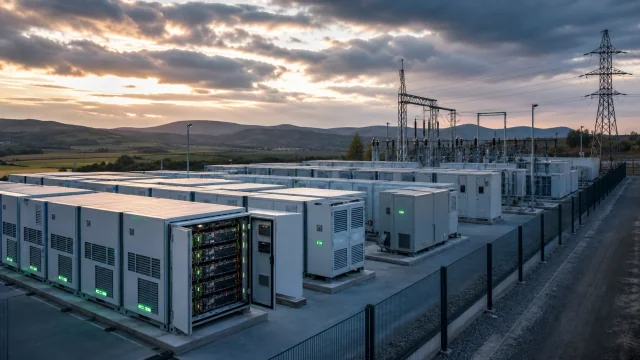
Bulgaria's product fee for industrial lithium-ion batteries is equivalent to about EUR 2.81/kg. Industry group BASEL wants a separate rate for stationary storage, arguing that the current framework does not reflect how utility-scale BESS is built or recycled.
At a glance
Bulgaria's rapid build-out of battery storage is bringing a previously overlooked project cost into sharper focus: the product fee that can apply to industrial lithium-ion batteries placed on the national market.
The Bulgarian Association of Electrical Engineering and Electronics, known as BASEL, is calling for stationary energy storage to receive its own treatment under the country's product-fee framework. Its argument is that the current industrial-battery category does not adequately reflect the design, operating life or end-of-life management of modern BESS facilities.
What the current Bulgarian rate actually means
Bulgaria's product-fee ordinance sets the equivalent of about EUR 2.81 per kilogram for rechargeable industrial lithium-ion batteries. The original text states BGN 5.50/kg, the value before Bulgaria adopted the euro. Traction batteries used in hybrid and electric vehicles are excluded. Under the EU Batteries Regulation, stationary storage systems fall within the industrial-battery category.
This does not mean that the fee is automatically charged on every kilogram of every imported BESS installation. Producers and importers may meet their waste-management obligations through a collective recovery scheme or an approved individual arrangement. The state fee applies when those obligations have not been met through another permitted route or the company cannot prove compliance.
The real cost therefore depends on how the equipment is supplied, which company is legally responsible, which components are included and how their weight is classified. Applying the headline rate automatically to the full weight of a containerised BESS would be an oversimplification.
The '14 times higher' comparison needs context
In a position distributed by the Bulgarian News Agency, BASEL compares the Bulgarian equivalent of roughly EUR 2.81/kg with an estimated EUR 0.20/kg level in Romania. On that basis, it describes the Bulgarian burden as around 14 times higher.
That comparison is best understood as the industry's case for reform rather than a complete cross-border legal benchmark. The publicly available material reviewed by Bulgarify is not sufficient to establish that EUR 0.20/kg is a universal Romanian state tariff applied to every stationary BESS under directly comparable conditions.
National systems may differ in their fees, the equipment included in the calculation and the documents required to prove compliance. A fair project comparison therefore requires more than placing two headline rates side by side.
BASEL's proposal for stationary storage
BASEL is proposing a dedicated rate of EUR 0.30/kg for stationary lithium-ion batteries. It also argues that the calculation should be based on the mass of the battery cells or modules, rather than the entire installation including containers, thermal management, fire suppression, power electronics and other balance-of-system equipment.
The distinction matters. A utility-scale storage plant contains substantial equipment that belongs to different product categories and follows different recovery routes. A clearer boundary could reduce the risk of inconsistent classification and prevent the battery fee from being calculated across an unnecessarily broad physical base.
The latest ministry proposal does not cover stationary batteries
On 17 August, Bulgaria's Ministry of Environment and Water announced draft changes that would cut selected product fees for electrical and electronic equipment by a factor of four. The ministry said the objective was to align the fees more closely with the actual cost of collection and treatment.
The proposal concerns electrical and electronic equipment; it does not create a dedicated category or rate for stationary lithium-ion batteries. BASEL's request therefore remains a separate policy issue, with no published timetable for a regulatory amendment.
What BESS investors should verify
The practical lesson for investors is not to assume either the full statutory rate or a lower quoted market figure without project-specific confirmation. The applicable treatment should be established before the equipment supply contract is finalised.
Key checks include the entity legally placing the batteries on the Bulgarian market, its membership of a collective scheme, the declared mass and classification of the battery components, responsibility for future recovery, and the documents required to prove compliance.
The cost also belongs in the project's financial model. At utility scale, even a modest difference per kilogram can change the initial investment. Unclear contracts may also shift an unexpected cost between the manufacturer, supplier, system integrator and asset owner.
A rulebook catching up with a fast-moving market
Bulgaria's storage pipeline is now large enough to justify rules tailored to stationary BESS. A dedicated rate would not have to mean weaker environmental responsibility. It should be grounded in realistic costs for collection, transport, safe treatment and recycling, while preserving a credible funding mechanism for the batteries' eventual end of life.
Until the legislation changes, each delivery needs careful structuring and written confirmation of the applicable compliance route. For the market, the durable solution will be one that is clear enough for investors, competitive enough for deployment and sufficiently funded to cover the real environmental obligations created by a rapidly expanding BESS fleet.